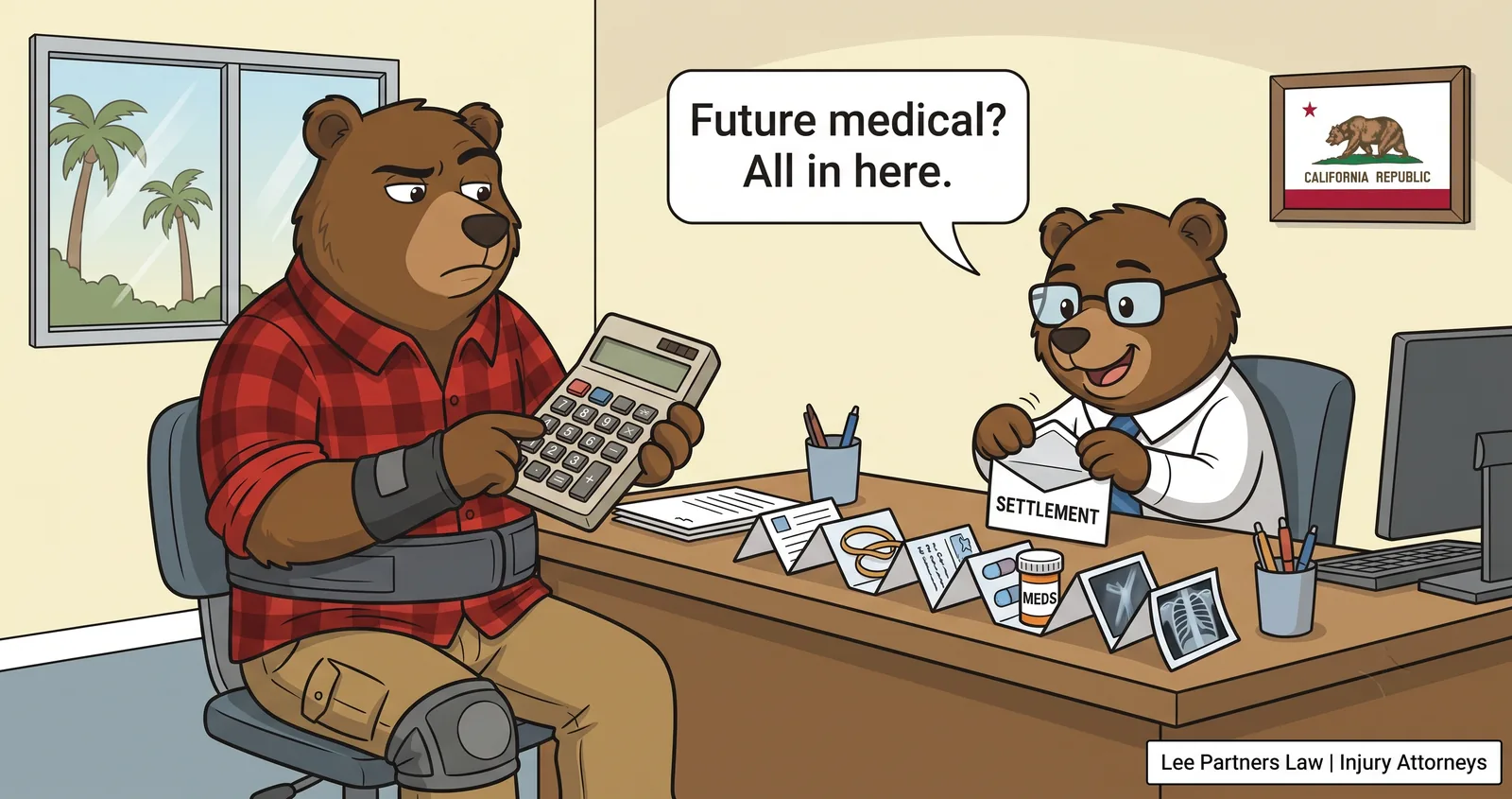

The adjuster offers a lump sum and says it includes your future medical care. You know you still need treatment, but there is no explanation of how much of the offer accounts for it. You are being asked to make a long-term decision without seeing the assumptions behind the number.
Future medical care can be a significant part of a California workers’ compensation settlement. There is no single buyout amount that fits everyone with the same diagnosis. The medical recommendations, likely treatment, disputed issues, and terms of the agreement all need to be considered.
Start with what you would be giving up
In a Compromise and Release that closes future medical care, you generally take responsibility for the covered future treatment after settlement. With Stipulations and an award preserving medical care, the insurer generally remains responsible for qualifying treatment, subject to the applicable rules. The DWC explains this distinction in its overview of case resolution.
Our comparison of Stipulations and Compromise and Release covers the structures in more detail. For a medical buyout, the immediate question is practical: what treatment might you need, and how would you obtain and pay for it after signing?
Do not evaluate the offer as though every dollar is available for ordinary spending. Ask what is included, what deductions or credits apply, and whether any funds require special handling. A Compromise and Release also takes effect only after a workers’ compensation judge reviews it and finds it adequate under Labor Code section 5001, but that review is not a substitute for understanding the agreement yourself before you sign.
The medical report should support the discussion
A useful future-care opinion explains what treatment is anticipated and why. It may address follow-up visits, medication, therapy when appropriate, injections, equipment, or possible surgery. A vague statement that care may be needed makes a careful valuation harder.
The questions become more specific once you look at the actual condition. Is another procedure reasonably anticipated or only a remote possibility? How often has treatment been needed? What has helped, what has failed, and what does the doctor recommend next? Those are medical questions that should not be replaced with guesses from a settlement website.
For someone with a back injury, our California back settlement guide discusses how the medical record fits into case value. A past surgery can matter, but it does not by itself establish that another surgery will occur or what a buyout should be.
Unsure whether a settlement offer accounts for the care you may need? Call 310-295-0822 or text Lee Partners Law. We can review the medical recommendations and the proposed settlement in a free consultation.
Why two similar injuries can produce different estimates
Imagine two workers with similar shoulder diagnoses. One is managing with occasional follow-up care and has no further procedure recommended. The other has persistent limitations and a supported recommendation for additional treatment. Even if their impairment ratings are similar, the future-care discussion may be quite different.
Timing matters too. An estimate spread over many years is not necessarily negotiated as the simple total of every possible future bill. The likelihood of treatment, anticipated cost, time horizon, and disputes about responsibility affect the parties’ positions. Settlement is a negotiation informed by evidence, not a guaranteed reimbursement of every imagined expense.
Ask which assumptions support the offer. If the insurer assumes minimal treatment but the doctor recommends ongoing care, that difference should be addressed before you sign. Our article on signs a workers’ comp offer may be too low discusses other issues to examine.
Your impairment rating is not a medical budget
Whole person impairment and permanent disability help address the lasting effects of the injury under California’s rating system. They do not tell you the cost of future appointments, prescriptions, or surgery. A modest rating does not automatically mean there is little need for medical care.
Keeping medical care open also does not mean unlimited treatment on demand. California’s treatment standard concerns care reasonably required to cure or relieve the effects of the injury, with medical guidelines and authorization rules applying. Labor Code section 4600 sets out the underlying treatment obligation.
Do not assume another health plan will pick up the bills
Before closing medical care, check how the proposed arrangement interacts with any other coverage. Private insurance coverage depends on the actual plan and circumstances. A general statement that you can “just use your health insurance” is not enough to build a treatment plan around.
Medicare raises additional issues. If you receive Medicare or expect to become eligible, the settlement needs appropriate review of Medicare’s interests. A workers’ compensation Medicare set-aside, when applicable, concerns funds for future injury-related care otherwise covered by Medicare. It is not a separate bonus or automatically the full value of future care. The federal Medicare program publishes its own guidance on workers’ compensation set-asides, and the settlement should be reviewed against it.
Common questions about medical buyouts
What is a medical buyout in workers’ comp?
A medical buyout is the part of a Compromise and Release that pays a lump sum in exchange for closing the insurer’s responsibility for future injury-related treatment. After the settlement is approved, the treatment becomes your responsibility to arrange and pay for. The amount is negotiated from the medical evidence about what care is likely, not calculated from a fixed schedule.
Can I reopen my case for treatment after a Compromise and Release?
Generally, no. A Compromise and Release that closes future medical care is intended to be final, and the limited grounds for setting one aside are narrow. That is the reason to have the future-care opinion and the settlement terms reviewed before signing rather than after a treatment request is refused.
Do I need a Medicare set-aside to settle?
Not every case needs one. Whether a set-aside is appropriate depends on your current Medicare status, whether you are reasonably expected to become a beneficiary soon, the settlement amount, and CMS’s review guidelines. What every case needs is a settlement that considers Medicare’s interests where they exist, so that future care remains payable. Ask how the proposed agreement handles that question before you agree to it.
Help for injured workers in Ventura County
For workers in Ventura, Oxnard, or Thousand Oaks, an immediate cash payment may be appealing after months of disrupted income. That pressure makes it especially useful to separate what you need now from the treatment you may need later. Our Ventura County workers’ compensation guide explains the broader benefits involved.
Lee Partners Law reviews the medical evidence and proposed terms so the decision is based on more than the size of the check. We want to know what the agreement closes, what treatment remains likely, and whether the offer has accounted for the supported needs.
Before accepting a medical buyout you do not understand, call or text us. Have the offer and the latest future-medical opinion available so we can discuss the actual terms. The consultation is free.
Prefer to write? Use the contact form just below this article and we will get back to you.