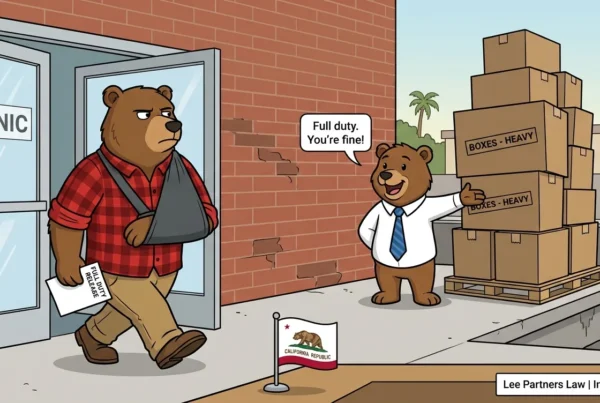
The insurance company picked the doctor list. Then it ignored the doctor.
One of the most frustrating parts of California workers’ compensation is this:
The insurance company usually controls the Medical Provider Network, also called the MPN. That means they give you the list of doctors. You pick a doctor from their list. That doctor examines you, treats you, reviews your MRIs, tries physical therapy, tries injections, and eventually says, “This worker needs surgery.”
Then the insurance company sends that surgery request to Utilization Review, and UR says no.
That is the part injured workers have a hard time understanding.
And honestly, I get it.
You are not asking to treat with your cousin’s doctor. You are not making up your own treatment plan. You are going to a workers’ comp doctor from the insurance company’s own network. But when that doctor requests surgery, injections, therapy, medication, diagnostic testing, or another form of treatment, the insurance company can still deny it through UR.
That does not mean your doctor is bad. It does not mean your case is over. It does not always mean the surgery will never happen.
But it does mean you need to understand the timelines and the next move.
What is Utilization Review in California workers’ comp?
Utilization Review, or UR, is the process the insurance company uses to decide whether requested medical treatment is medically necessary under California workers’ compensation rules.
Your treating doctor does not simply say, “I recommend surgery,” and then surgery automatically happens.
The doctor usually submits a Request for Authorization, commonly called an RFA. The RFA is sent to the claims administrator or insurance company. The insurance company then sends it to UR.
UR can do one of three things:
- Approve the treatment.
- Modify the treatment.
- Deny the treatment.
For injured workers, a “modification” often feels the same as a denial. Maybe the doctor requested 12 physical therapy sessions and UR approved 6. Maybe the doctor requested surgery and UR denied it. Maybe the doctor requested a specific medication and UR approved something else.
The important thing to understand is that UR is not the same thing as a QME.
UR is not deciding your permanent disability. UR is not deciding settlement value. UR is not deciding whether you are a good person or whether you are really hurt.
UR is deciding whether the requested medical treatment meets the applicable medical treatment guidelines.
Surgery denials are extremely common
If your workers’ comp surgery was denied, you are not alone.
According to the California Division of Workers’ Compensation’s 2026 Independent Medical Review report analyzing 2025 data, surgery requests challenged through IMR were upheld 89.2% of the time.
In plain English, that means when UR denied or modified surgery and the injured worker challenged it through IMR, the UR decision was still upheld almost 9 out of 10 times.
That number is brutal for injured workers.
It means IMR can work, but you should not assume IMR is an easy fix. Most of the time, IMR agrees with UR.
That is why the next step matters.
Sometimes the right move is IMR. Sometimes the right move is a new RFA with better documentation. Sometimes the problem is not really UR at all and needs to be addressed through a QME, AME, or court process.
The basic UR timeline
For most treatment requests, once the insurance company receives a completed RFA, UR generally has to make a decision within 5 business days.
This is the normal timeline for prospective or concurrent review.
Prospective review means the treatment has not happened yet. This is the most common situation with surgery, injections, physical therapy, medication, imaging, and specialist referrals.
Concurrent review means the treatment is already ongoing and the doctor is asking to continue it.
For expedited review, the timeline can be much faster. If the injured worker faces an imminent and serious threat to health, or if the normal UR timeline would be detrimental to the worker’s condition, the requesting doctor can certify the need for expedited review.
In that situation, the decision is generally due within 72 hours after receipt of the information reasonably necessary to make the decision.
But here is the practical point:
Most surgery requests are not treated as expedited, even when the injured worker is in severe pain. Severe pain alone does not always mean UR will treat the request as expedited. The doctor has to properly document why the faster timeline applies.
What happens if UR says it needs more information?
Sometimes UR does not immediately approve or deny the treatment. Instead, UR says it does not have enough information.
That can happen when the RFA is missing records, the doctor did not explain the basis for the request, the MRI report is missing, prior conservative care is unclear, or the request does not address the medical treatment guidelines.
If UR needs more information, it generally has to request that information from the treating doctor within 5 business days from receipt of the RFA, but no longer than 14 days. The decision must be made within 14 total days from receipt of request.
This is important because UR cannot just sit on the request forever.
If the missing information is not received within the applicable deadline, UR may issue a denial based on the missing information. The denial should usually say the request will be reconsidered if the missing information is later received.
This is one of the biggest practical problems in workers’ comp treatment disputes.
The injured worker thinks, “My surgery was denied.”
The doctor thinks, “UR did not get the records it needed.”
The adjuster thinks, “We followed the process.”
And the worker is stuck waiting in pain.
What should you look for in the UR denial letter?
When treatment is denied, do not just look at the first page and throw it away.
The UR denial letter matters.
Look for these things:
1. What exactly was denied?
Was it the surgery itself? A surgical consult? Preoperative clearance? An inpatient stay? An assistant surgeon? A specific implant or device?
This matters because “surgery denied” can mean different things.
Sometimes UR denies the actual surgery. Sometimes UR approves surgery but denies the hospital stay. Sometimes UR denies part of the surgical package. Sometimes UR denies the consult before surgery ever gets fully considered.
2. Why was it denied?
The denial should explain the medical reason.
For example, UR may say there was not enough conservative treatment, no documented functional improvement, no neurological deficit, no instability, no objective findings, no failed injections, or no guideline support.
You want to know the actual reason because that reason tells you how to attack the problem.
3. Did UR rely on missing information?
If the denial says records were missing, that may be fixable.
Maybe the doctor did not attach the MRI. Maybe the physical therapy notes were not included. Maybe the doctor failed to explain why the surgery is needed now. Maybe the doctor did not address the prior UR denial.
This is not always the end. Sometimes the solution is a better RFA.
4. Was the denial timely?
UR deadlines matter.
If UR misses the deadline, there may be an argument that the denial is defective and that the Workers’ Compensation Appeals Board can address the treatment dispute.
These are technical arguments and they are very fact-specific, but timing should always be reviewed.
5. Does the denial include IMR paperwork?
If UR denies or modifies treatment based on medical necessity, the injured worker usually has the right to request Independent Medical Review.
Do not ignore the IMR form. There is a deadline.
What is IMR?
Independent Medical Review, or IMR, is the appeal process for most UR medical necessity denials in California workers’ compensation.
If UR denies treatment, the injured worker can request IMR. IMR sends the dispute to an independent reviewer who looks at the medical records and decides whether UR was correct.
For most treatment disputes, the IMR application generally must be submitted within 30 days after service of the UR decision. For formulary medication disputes, the deadline is shorter.
This is one of those deadlines injured workers should not play around with. If you miss the IMR deadline, you may lose that appeal route.
The problem with IMR
IMR is important, but injured workers need to understand the reality.
IMR usually upholds UR.
For surgery requests, the 2026 IMR report analyzing 2025 data found that UR decisions were upheld 89.2% of the time.
That does not mean you should never file IMR. Sometimes IMR is absolutely worth doing. Sometimes UR made a clear mistake. Sometimes the records support the treatment. Sometimes the denial is weak.
But if the RFA was poorly written, if the doctor did not attach the right records, or if the request does not address the treatment guidelines, IMR may just rubber-stamp the UR denial.
That is why the question is not only:
“Can I appeal?”
The better question is:
“What is the best way to actually get this treatment authorized?”
Sometimes that means IMR. Sometimes that means fixing the medical record and resubmitting. Sometimes that means going to a QME or AME. Sometimes that means going to court because the insurance company is using UR incorrectly or refusing to address a real change in the facts.
What if the doctor resubmits the same surgery request?
This is where many injured workers get trapped.
If the same doctor requests the same treatment again after UR already denied it, the insurance company may say it does not have to send the request back to UR.
In plain English, they may say:
“We already denied this. You cannot just keep asking for the same thing.”
But there is a major exception.
If there has been a documented change in material facts, the request may need to be reviewed again.
What is a material change in facts?
A material change in facts means something important changed after the prior denial.
Examples may include:
- New MRI findings
- Worsening symptoms
- New objective findings on exam
- Failed physical therapy
- Failed injections
- Failed medication
- New neurological symptoms
- Worsening weakness, numbness, or loss of function
- A new surgical opinion
- Better explanation from the treating doctor
- Records that were missing before but are now included
- A QME or AME report supporting the need for treatment
The key is that the doctor needs to explain the change clearly.
It is not enough for the doctor to write:
“Please authorize surgery again.”
A stronger resubmission says something like:
“Since the prior UR denial, the patient has completed additional conservative treatment without improvement. Updated examination shows worsening radicular symptoms and decreased function. The prior denial was based in part on lack of conservative care and lack of updated findings. Those facts have changed. Surgery is now medically necessary.”
That is much better than simply sending the same request again.
The doctor’s RFA matters a lot
This is the part injured workers do not always see.
Sometimes treatment gets denied because the treatment really does not meet the guidelines.
But sometimes treatment gets denied because the request was weak.
The doctor may be right that you need surgery, but the RFA still has to explain why.
For surgery, a strong RFA usually needs to address:
- Your diagnosis
- Objective findings
- MRI, EMG, X-ray, or other diagnostic testing
- Prior treatment tried and failed
- Functional limitations
- Why surgery is reasonable and necessary
- Why the request meets or should be allowed under the medical treatment guidelines
- Why any prior UR denial no longer applies
- What changed since the last denial, if anything
A one-line surgery request is much easier for UR to deny.
What can you do after surgery is denied?
Here are the main options.
Option 1: File IMR
If the denial is based on medical necessity, IMR is usually the formal appeal route.
This can make sense when the records are strong and UR appears wrong.
But remember: IMR often upholds UR. So filing IMR is not always enough by itself.
Option 2: Have the doctor fix and resubmit the request
If the denial was based on missing records, lack of documentation, or failure to explain why the treatment is needed, the doctor may be able to submit a better RFA.
This is especially important when there is a documented change in material facts.
The resubmission should not be lazy. It should directly address the reason for the prior denial.
Option 3: Develop the medical record
Sometimes the case is not ready for surgery authorization yet.
That does not mean surgery will never happen.
It may mean the doctor needs to document failed conservative treatment, order updated imaging, explain worsening symptoms, perform additional testing, or clarify the diagnosis.
In workers’ comp, documentation is everything.
Pain matters. Your symptoms matter. But UR and IMR are record-driven. If it is not documented, it may as well not exist.
Option 4: Use the QME or AME process
If the dispute involves causation, accepted body parts, work restrictions, permanent disability, future medical care, or whether the condition is industrial, a QME or AME may be necessary.
A strong QME report can change the direction of a case.
It may also help create the medical foundation for renewed treatment requests.
Option 5: Go to court when the issue is not really medical necessity
Sometimes the insurance company uses UR when the real dispute is legal. Sometimes they defer UR because they dispute liability. Sometimes they refuse to send a new request to UR even though the doctor documented a material change in facts.
Those situations may need to be addressed at the Workers’ Compensation Appeals Board.
Do not assume the first denial is the end
A UR denial is not good. It can delay your recovery for months. It can be extremely stressful. It can make you feel like the whole system is rigged against you.
But a denial is not always the end.
The key is figuring out why it was denied and what the correct next step is.
Was the denial timely?
Was the RFA complete?
Were the right records attached?
Did the doctor address the medical treatment guidelines?
Was there a prior denial?
Has anything changed since that prior denial?
The practical takeaway
California workers’ comp treatment disputes are frustrating because the system often feels backwards.
The insurance company has the MPN. You treat with a doctor from that network. That doctor requests treatment. Then the insurance company uses UR to deny the treatment its own network doctor recommended.
That is the reality of the system.
But a UR denial does not always mean the treatment is dead. The denial letter, the medical records, the reason for the denial, and the next step all matter.
Sometimes the answer is IMR. Sometimes the doctor needs to submit a stronger RFA. Sometimes there needs to be a clear documented change in facts. Sometimes the issue needs to be addressed through a QME, AME, or court process.
At Lee Partners Law: Injury Attorneys, David A. Lee and Michael E. Lee are Certified Specialists in Workers’ Compensation Law by the State Bar of California Board of Legal Specialization. We represent injured workers throughout California dealing with denied surgery, delayed treatment, UR denials, IMR appeals, QME disputes, and insurance companies that refuse to listen to their own MPN doctors.
If your workers’ comp surgery or medical treatment was denied, contact Lee Injury Attorneys LLP for a free consultation. We can review the denial letter, the timeline, the medical records, and the next best step to try to get your case moving forward