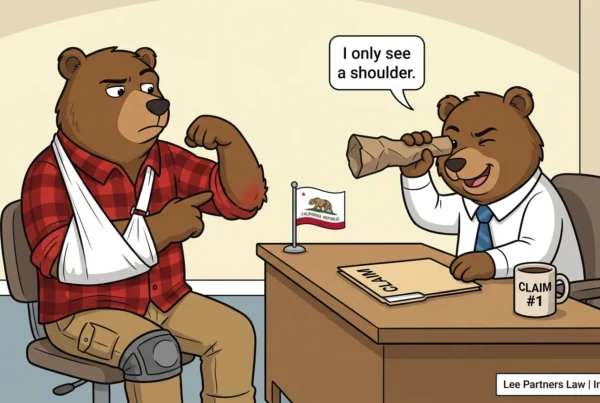
You reported an injury at work. You filled out the paperwork. Maybe your wrist started hurting after years of typing. Maybe your back finally gave out after years of lifting. Maybe you suffered one specific accident that your supervisor knew about.
Then the insurance company sent you a letter saying your workers’ compensation claim was denied.
That letter can look final.
It is not.
A denial is the insurance company’s position. It is not a ruling from a workers’ compensation judge, and it does not necessarily mean your case is over.
In fact, many California workers’ compensation claims, especially cumulative trauma claims, are denied before the medical evidence has been fully developed.
The important questions are:
- Why did the insurance company deny the claim?
- Is the defense legally valid?
- What medical evidence exists?
- Do you need a Qualified Medical Evaluator, or QME?
- Does the case need to be brought before a workers’ compensation judge?
At Lee Partners Law, David Lee and Michael Lee are California Certified Specialists in Workers’ Compensation Law and former workers’ compensation defense attorneys. We spent years seeing how claims were evaluated from the insurance side. Today, we represent injured workers.
If your claim was denied, call or text us at 310-295-0822. We can review the denial and explain what the insurance company is actually arguing.
A Workers’ Comp Denial Is Not the Same Thing as Losing Your Case
This is the first thing injured workers need to understand.
The insurance company decides whether it will voluntarily accept your claim.
It does not get the final word on whether your injury is compensable.
A denied claim can be litigated before the California Workers’ Compensation Appeals Board. An injured worker can file an Application for Adjudication, develop medical evidence, request a hearing and ultimately have the dispute decided by a workers’ compensation judge.
People commonly call this “appealing” a workers’ comp denial. Technically, you are not appealing a judge’s ruling. You are challenging the insurance company’s denial.
The denial letter is the beginning of the dispute, not the end.
Why Do Insurance Companies Deny Workers’ Compensation Claims?
Most denials fall into a few common categories:
- There is allegedly not enough medical evidence.
- The insurance company says work did not cause the injury.
- The claim was filed after termination or layoff.
- The injury was allegedly reported too late.
- The statute of limitations allegedly expired.
- There was a preexisting condition.
- The insurance company disputes how the accident happened.
- The employer claims the worker was an independent contractor.
- The carrier raises a less common defense such as intoxication or horseplay.
Some defenses are serious. Others sound much stronger in a denial letter than they are once the evidence is developed.
The first step is determining exactly why the claim was denied and what evidence is needed to attack that reason.
“There Is Not Enough Medical Evidence”
This is one of the most frustrating workers’ compensation denials because it creates a Catch-22.
Imagine you work at a computer every day.
Over time, your hands and wrists begin hurting. Eventually the numbness becomes bad enough that you report a workers’ compensation injury.
What medical evidence do you have at that point?
Maybe very little.
You cannot diagnose yourself with carpal tunnel syndrome. You cannot write your own medical report explaining whether years of repetitive typing caused your condition.
You reported the injury because you needed medical care.
Then the insurance company denies the claim because there is supposedly “insufficient medical evidence.”
That is where the QME process becomes extremely important.
QME, QME, QME: The Doctor Who Can Change a Denied Case
When there is a medical dispute over whether an injury is work related, California law provides a process for obtaining a medical-legal evaluation.
That doctor is usually a Qualified Medical Evaluator.
The QME can address questions such as:
- Did you sustain an injury?
- Did your work cause or contribute to the condition?
- Did you suffer a cumulative trauma?
- Which body parts were injured?
- Do you need additional treatment?
- Do you have temporary or permanent disability?
For a deeper explanation, see our guide to the California QME process.
We also explain how injured workers should prepare in our article on how to prepare for a QME examination.
Who Pays for the QME If My Claim Is Denied?
The insurance company cannot simply deny your claim and tell you that you must personally pay thousands of dollars for the medical-legal process.
When a medical-legal evaluation is properly obtained through California’s workers’ compensation system, Labor Code §4064 generally makes the employer responsible for the reasonable and necessary cost.
There are technical rules for properly obtaining a QME panel, particularly depending on whether you are represented by an attorney.
But the basic point is important:
A denied claim does not mean you lose access to the QME process.
What If the QME Says My Injury Is Work Related?
A favorable QME report can completely change a denied case.
Suppose the insurance company denies a wrist claim for lack of medical evidence.
The QME then:
- Reviews the employee’s work history.
- Takes a detailed history of repetitive typing.
- Reviews medical records and nerve testing.
- Examines the wrists and hands.
- Diagnoses carpal tunnel syndrome.
- Concludes that repetitive work caused or contributed to the condition.
The evidence is now very different from what existed when the claim was denied.
The insurance company can accept the claim.
If it refuses, the QME report can become evidence before a workers’ compensation judge.
A QME does not technically decide the case. Judges decide disputed claims.
But medical causation is usually a medical question, which is why the medical-legal evidence is so important.
“Your Injury Was Not Caused by Work”
Another common denial is that the condition did not arise out of employment.
The carrier may claim:
- Your condition is degenerative.
- Your condition existed before the injury.
- Your job duties could not have caused it.
- Your symptoms came from activities outside work.
Again, the adjuster does not get to decide medical causation simply by writing it in a denial letter.
Preexisting Conditions Do Not Automatically Destroy a Claim
You can have arthritis before a work injury.
You can have an old back problem.
You can have degenerative changes on an MRI.
That does not automatically mean your work could not have aggravated or contributed to the condition.
Causation of the injury and apportionment of permanent disability are also different issues.
A carrier cannot simply point to an old MRI, say “degenerative,” and treat the analysis as finished.
The medical evidence matters.
Why Are Cumulative Trauma Claims So Often Denied?
Cumulative trauma claims are particularly vulnerable to early denials because there may be no single accident.
A warehouse worker may lift for years before developing back or shoulder problems.
A delivery driver may repeatedly load and unload packages before knee symptoms become severe.
An office worker may type for thousands of hours before hand numbness develops.
California recognizes cumulative injuries caused by repetitive physical or mental activities occurring over time.
For a complete explanation, see our California cumulative trauma guide.
The difficult issue is often proving medical causation.
An adjuster can say the condition is age-related.
A QME has to actually evaluate the work exposure, medical history and medical evidence.
That is one reason cumulative trauma claims are frequently denied early and later litigated.
“You Filed the Claim After You Were Fired”
The post-termination defense is real.
But it is not as simple as:
“You filed after you were terminated, therefore you lose.”
Labor Code §3600(a)(10) contains important exceptions.
Your Employer Already Knew You Were Injured
Suppose you injured your back and told your supervisor.
Two weeks later, you were terminated.
You then formally filed a workers’ compensation claim.
The fact that the paperwork came after the termination does not automatically defeat the case.
Evidence of prior employer knowledge can include:
- Text messages.
- Emails.
- Incident reports.
- Witness testimony.
- Requests for medical care.
- Work restrictions.
- Communications with management.
You Had Medical Records Before the Termination
Another important exception involves medical records existing before the termination notice.
Maybe you had not filed a formal workers’ compensation claim yet, but you had already gone to a doctor and reported that repetitive lifting at work was hurting your back.
That medical record may become very important.
Cumulative Trauma Changes the Analysis
This is where California workers’ compensation law gets strange.
For a cumulative trauma, the legal “date of injury” is not necessarily the last day you worked.
Labor Code §5412 generally places the date of injury when disability and knowledge that the disability was caused by employment come together.
That date can occur after employment has ended.
It is essentially a legal fiction, but it can make a major difference.
Labor Code §3600 specifically recognizes circumstances where the §5412 cumulative-trauma date of injury occurs after the employee receives notice of termination.
That is why a denial letter saying:
“Claim denied because it was filed after termination”
does not finish the analysis.
Especially in a cumulative trauma case.
“You Reported the Injury Too Late”
There are several different deadlines in California workers’ compensation, and they frequently get mixed together.
The 30-Day Notice Rule
Labor Code §5400 generally requires notice of an injury within 30 days.
But employer knowledge matters.
If your supervisor knew you were injured at work, the insurance company may have difficulty later claiming that the employer had no notice.
That is why texts, emails, witness statements and incident reports can become critical evidence.
The One-Year Statute of Limitations
Labor Code §5405 generally creates a one-year limitations period measured from specified events, including the date of injury, disability payments or the last furnishing of medical benefits.
But the analysis can become much more complicated depending on the facts.
Do not automatically assume your case is dead because more than one year has passed since an accident.
We cover this issue separately in our guide: Is It Too Late to File a Workers’ Compensation Claim in California?
Cumulative Trauma Has a Different Date-of-Injury Rule
For cumulative trauma claims, Labor Code §5412 again becomes important.
The legal date of injury may be much later than when symptoms first began.
If your claim was denied as untimely, the entire timeline needs to be analyzed.
What About Intoxication?
California workers’ compensation is generally a no-fault system, but intoxication can be a defense.
It is a relatively narrow defense.
Labor Code §5705 places the burden of proving the intoxication defense on the employer.
Evidence that someone consumed alcohol does not automatically prove that intoxication caused the injury.
Likewise, finding a substance in someone’s system does not automatically resolve whether the substance was unlawfully used, whether the worker was impaired or whether the impairment caused the accident.
These cases are highly dependent on the actual evidence.
What If the Insurance Company Says I Was Engaged in Horseplay?
Horseplay is another relatively uncommon defense.
Not every moment of joking around at work removes someone from workers’ compensation coverage.
The issue generally involves whether the worker substantially departed from employment for personal amusement.
There is a major difference between completely abandoning your work to engage in dangerous horseplay and briefly joking with a coworker while still performing your job.
There is also a difference between participating in horseplay and simply being injured by someone else’s conduct.
These cases are intensely factual.
The insurance company still has to prove the defense.
What If They Say I Was an Independent Contractor?
Another denial we see is:
“You were an independent contractor, not an employee.”
That can be a real dispute, but simply labeling someone an independent contractor does not necessarily decide the issue.
California looks at the actual working relationship and the applicable legal test.
If you were paid as a contractor but worked like an employee, the classification may need to be litigated. We see employers often misclassify employees to prevent paying payroll tax / workers compensation insurance / etc.
What Should I Do After My Workers’ Comp Claim Is Denied?
First, keep the denial letter.
It tells us exactly what the insurance company is claiming.
Then gather the important documents and evidence:
- DWC-1 claim form.
- Denial letter.
- Medical records.
- Work restrictions.
- Text messages or emails reporting the injury.
- Incident reports.
- Witness information.
- Termination documents if applicable.
- Insurance-company correspondence.
- Information about your actual job duties.
Then determine whether an Application for Adjudication needs to be filed and whether the case requires a QME.
For many medical-causation denials, the QME is the most important next step.
After that, you develop the evidence necessary to defeat the particular defense.
A statute-of-limitations case is not handled the same way as a post-termination claim.
A post-termination claim is not handled the same way as a medical-causation dispute.
You attack the defense the insurance company actually raised.
What Is the 90-Day Rule?
California also gives the insurance company a deadline to investigate the claim.
Under Labor Code §5402, once the claim form is filed, the claims administrator generally has 90 days to reject liability.
If the claim is not rejected within that period, the injury may be presumed compensable, subject to the statute’s rules and exceptions.
While a claim is under investigation, California law can also require authorization of medical treatment up to the statutory limit.
That is one reason the DWC-1 claim form matters.
Simply telling someone at work that you hurt does not always create the same procedural record as formally filing the claim.
How Do You Fight a Denied Workers’ Comp Claim?
You generally do not just send the insurance company a letter saying:
“I appeal.”
A denied California workers’ compensation claim can become a legal case before the Workers’ Compensation Appeals Board.
The process may include:
- Filing an Application for Adjudication of Claim.
- Developing medical evidence.
- Obtaining a QME or AME evaluation.
- Obtaining employment and medical records.
- Filing a Declaration of Readiness to Proceed.
- Appearing at a Mandatory Settlement Conference.
- Going to trial if the dispute cannot be resolved.
That is your opportunity to have the case decided by a judge.
The adjuster does not replace the judge.
What Happens at Trial?
The insurance company presents its evidence.
You present yours.
Depending on the dispute, the evidence can include:
- QME or AME reports.
- Treating physician reports.
- Medical records.
- Your testimony.
- Supervisor or coworker testimony.
- Employment records.
- Injury reports.
- Text messages and emails.
- Deposition testimony.
The workers’ compensation judge then determines whether the injury is compensable and whether the insurance company proved any applicable defenses.
A judge can find an injury compensable even though the insurance company previously denied it.
That is why a denial letter should never be confused with a judicial decision.
What If the QME Is Against Me?
A bad QME report makes the case harder.
It does not mean the report should be accepted without analysis.
We look at whether the physician:
- Had an accurate history.
- Reviewed the important medical records.
- Understood the actual job duties.
- Addressed all claimed body parts.
- Used the correct causation standard.
- Explained the medical reasoning.
- Addressed contradictory evidence.
Depending on the case, further development may include a supplemental report or deposition of the QME.
A medical report has to be substantial medical evidence. A doctor’s signature alone does not make every conclusion legally sufficient.
A Denied Claim Is Different From Denied Medical Treatment
This distinction matters.
If the insurance company accepts your injury but denies an MRI, surgery, therapy, injection or another treatment request, that is generally a medical-treatment dispute.
Those disputes commonly involve Utilization Review and Independent Medical Review.
That is different from the insurance company denying liability for the entire claim.
If your claim is accepted but treatment has been denied, read our guide to denied workers’ compensation medical treatment, UR and IMR.
If the problem is the doctor you are seeing, our guide to changing your workers’ compensation doctor explains another set of rights that may apply.
Can a Denied Claim Later Be Accepted?
Yes.
Claims move from denied to accepted after additional evidence is developed.
A common sequence is:
The employee files a claim.
The insurance company denies it for lack of medical evidence.
The employee obtains a QME.
The QME finds industrial causation.
The carrier accepts the claim.
Other cases require litigation.
The QME supports the injured worker, the insurance company continues denying the claim, and the case proceeds toward a hearing or trial.
The important point is simple:
Evidence changes cases.
The denial letter does not freeze the case forever.
Should I Hire a Workers’ Compensation Attorney After a Denial?
A denied claim is one of the clearest situations where speaking with a workers’ compensation attorney makes sense.
The insurance company has taken the position that it owes you nothing.
Medical treatment, temporary disability, permanent disability and other benefits may all depend on overturning that position.
At Lee Partners Law, David Lee and Michael Lee previously represented employers and insurance companies in California workers’ compensation cases.
Today, we represent injured workers.
We handle denied claims, cumulative trauma cases, disputed medical causation and complex workers’ compensation matters throughout Los Angeles, the San Fernando Valley, Burbank, Glendale, Pasadena, Ventura County, Orange County, the Inland Empire, the High Desert, San Diego and throughout California.
If your workers’ compensation claim was denied, send us the denial letter.
We want to know why they denied it.
Then we can determine how to attack it.
Call or text Lee Partners Law at 310-295-0822 for a free case review.
Frequently Asked Questions About Denied Workers’ Compensation Claims
Does a workers’ comp denial mean my case is over?
No. A denial is the insurance company’s position. A disputed claim can be developed and ultimately decided by a workers’ compensation judge.
Can the insurance company deny my claim before I see a QME?
Yes. But that does not prevent a properly obtained QME from later addressing whether your injury was caused by work.
Who pays for the QME on a denied claim?
When a reasonable and necessary medical-legal evaluation is properly obtained through California’s workers’ compensation process, the employer generally bears the cost under Labor Code §4064.
Can workers’ comp deny me because I was fired?
The insurance company can raise the post-termination defense, but important exceptions exist. Prior employer knowledge, pretermination medical records and the legal date of a cumulative trauma can change the outcome.
Can I file a cumulative trauma claim after I stop working?
Potentially, yes. California uses a special legal date of injury for cumulative trauma claims under Labor Code §5412.
What if I waited more than one year?
Do not assume the claim is automatically barred. The statute-of-limitations analysis depends on the actual timeline, the legal date of injury and other events in the claim.
Can a preexisting condition cause my case to be denied?
It can be raised as an issue, but a preexisting condition does not automatically prevent a work-related injury or aggravation.
Can I take a denied workers’ comp claim to court?
Workers’ compensation disputes are generally litigated before the Workers’ Compensation Appeals Board. A workers’ compensation judge can decide whether the injury is compensable.
Is denied medical treatment the same as a denied claim?
No. A treatment denial in an accepted case usually involves UR and IMR. A complete claim denial disputes liability for the injury itself.
Legal References
California Labor Code §§3208.1, 3600, 4060, 4064, 5400, 5401, 5402, 5405, 5412 and 5705.
This article provides general information about California workers’ compensation law. Every case depends on its particular facts, medical evidence and procedural history.