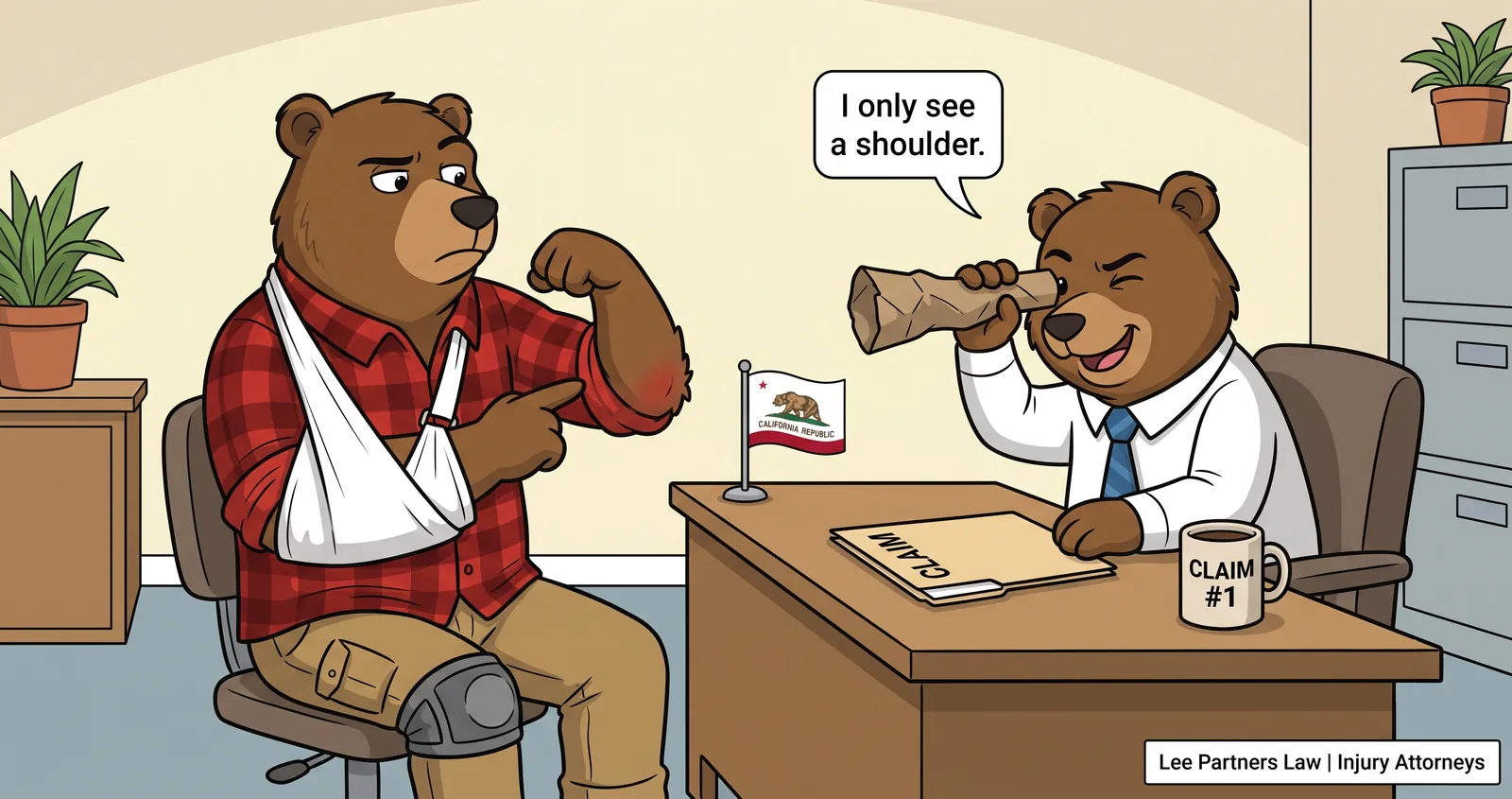

The insurance company accepted your shoulder injury. Your neck and elbow also hurt, but every appointment seems to focus on the shoulder. When you ask about the other symptoms, you are told those body parts are not on the claim.
Additional body parts or conditions can sometimes be included in a California workers’ compensation case. The issue is why they belong in the case and what evidence supports that connection. Mentioning a body part on a form is not the same as getting the insurer to accept responsibility for it.
Was it part of the original injury or something different?
An injury can affect more than one area even when the first report names only the most painful one. A worker who falls may focus on a swollen knee and mention the back pain later. That calls for a careful history of the original event and when each symptom appeared.
A different situation arises when a condition develops because of the original injury or its treatment. These are often called compensable consequences. For example, a doctor might need to evaluate whether an altered gait contributed to another problem. A medical explanation is necessary; the sequence alone does not prove the connection.
There can also be a separate accident or a repetitive injury requiring its own analysis. California recognizes both specific and cumulative injuries under Labor Code section 3208.1. For injuries caused by repetitive work, the history of exposure may also need review. A new incident should not be forced into the old claim just because the paperwork would be easier.
Tell the doctor what is happening, including the timing
Describe every symptom you believe needs evaluation and explain when it began. If it was present from the start but omitted from a report, say so. If it developed months later, explain that accurately. Previous injuries, other treatment, and changes in work duties also belong in the history.
Consider a hypothetical El Monte warehouse employee with an accepted shoulder claim and hand numbness. The worker should describe the numbness and its timing rather than assume it comes from the shoulder. The doctor may need to evaluate another cause or obtain additional information before reaching an opinion.
Keep copies of reports and ask whether the additional complaint was documented. Our QME report guide explains why a medical report needs to address the disputed issues, not merely list diagnoses.
Is the insurer treating one body part while ignoring another? Call 310-295-0822 or text Lee Partners Law. We can discuss what is missing and what evidence may be needed to address it.
How does another body part get addressed in the case?
The process can include notifying the insurer, obtaining a medical opinion about causation, and amending the court pleadings when appropriate under the Appeals Board’s rule on amended pleadings. A dispute may require a medical-legal evaluation and, if it cannot be resolved, a decision by a workers’ compensation judge. Changing the paperwork alone does not establish entitlement to treatment or disability benefits.
Ask your attorney whether the new condition is being claimed, whether the insurer accepts it, and what remains disputed. Those are separate questions. A condition can appear in a doctor’s chart while still being absent from the accepted claim or unresolved in the litigation.
Related conditions can involve more than orthopedic complaints. Our article on dental injuries, TMJ, and bruxism in workers’ compensation discusses another area that may need attention. Each claimed connection still needs its own supporting facts and medical analysis.
Does another condition automatically increase the settlement?
No. Treatment rights, permanent impairment, and settlement value are related but distinct issues. The medical findings, applicable rating rules, and any valid apportionment can affect the result. Multiple impairment values are not necessarily added together by simple arithmetic.
There are also special rules for certain consequences of physical injuries. For injuries on or after January 1, 2013, Labor Code section 4660.1 limits increased impairment ratings for consequential sleep dysfunction, sexual dysfunction, and psychiatric disorders. The statute preserves treatment rights and provides specified exceptions for psychiatric impairment. We are experts at identifying those exceptions to ensure that you receive the maximum value in your case.
The purpose of reviewing additional body parts is to make the case accurate and complete. It should never become an exercise in collecting diagnoses simply to increase a number.
Common questions about adding a body part
Do I need to file a new claim for a body part that was left off?
It depends on why the body part is missing. If it was injured in the same event or is a consequence of the accepted injury, the usual route is to add it to the existing claim with medical support. If it came from a separate incident or a distinct period of repetitive work, it may need its own claim with its own date of injury. Guessing wrong can create a timing problem, so get the history reviewed before anything is filed.
Can the insurance company refuse treatment for a body part that is not on the claim?
Insurers often deny treatment for a body part they have not accepted, and a utilization review decision about a specific treatment request is not the same as a decision about whether the body part is part of the injury. The causation question usually has to be answered by a treating doctor’s report or a medical-legal evaluation, and if the insurer still disagrees, by a workers’ compensation judge.
Will adding a body part slow down my case?
It can add time, because a new condition may need a medical opinion and a dispute may need to be resolved. However, it is always best to ensure that every single body part that has been injured is included in your case. A settlement that resolves the claim while a real injury is left out may be final as to that injury. The goal is an accurate case, not the fastest one.
Help for injured workers in the San Gabriel Valley
For injured workers in West Covina, Pasadena, and neighboring communities, our San Gabriel Valley guide explains the broader claim process. Lee Partners Law can review the medical record alongside the accepted and disputed portions of the case.
Before you settle a claim that seems to leave part of your injury out, call or text us for a free consultation.
Prefer to write? Use the contact form just below this article and we will get back to you.