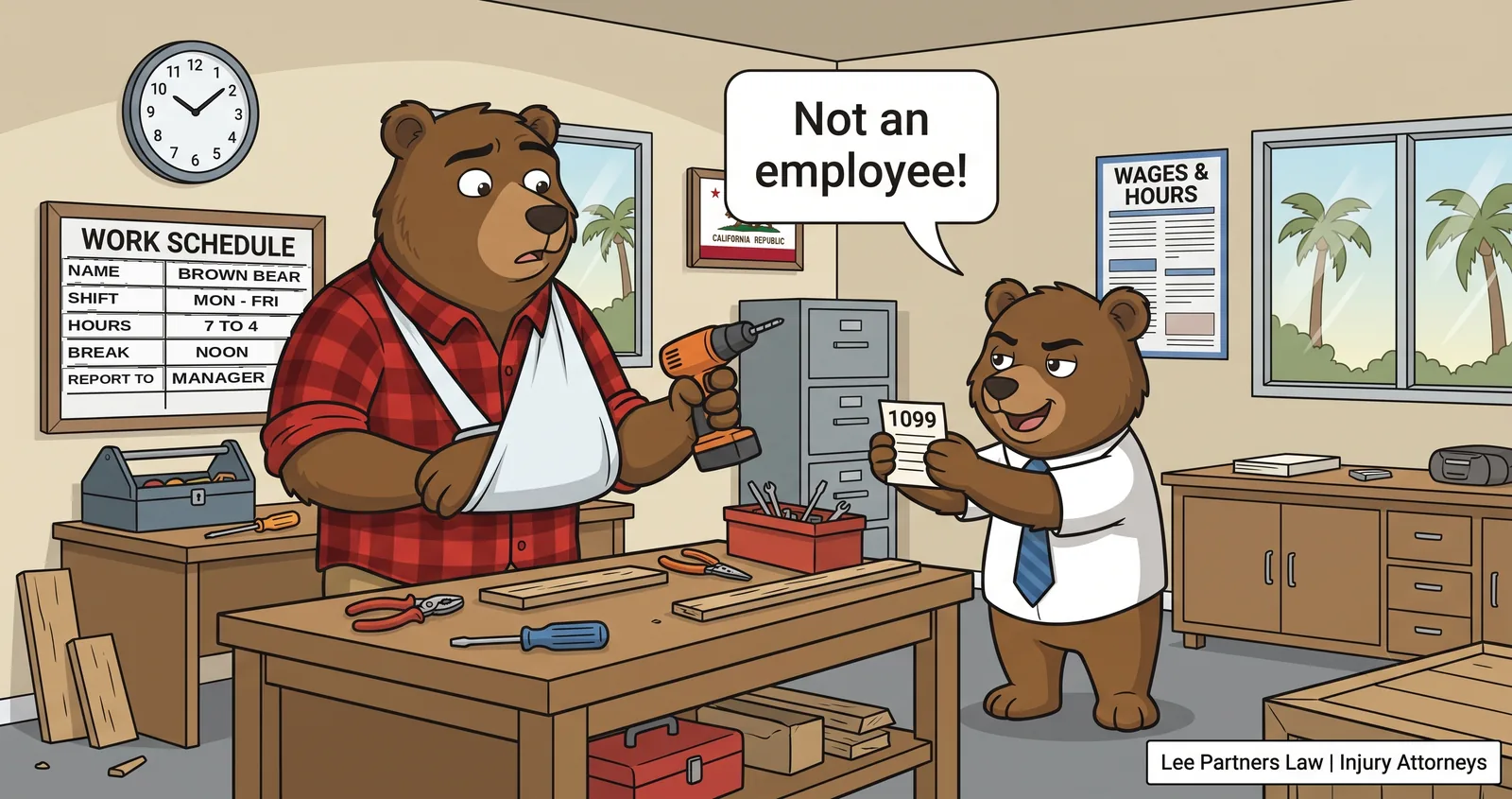

You worked the schedule you were given, followed the supervisor’s instructions, and got paid for the work. After an injury, the business tells you that you are an independent contractor and workers’ comp does not apply. The explanation comes down to a tax form.
A 1099 does not decide employee status by itself. Neither does signing an agreement with “independent contractor” at the top. California looks at the applicable legal test and the actual working relationship. Some contractors are properly classified, but some workers called contractors are legally employees.
Look at how the job actually worked
Start with the facts rather than the label. Who set your schedule and rate? Who assigned the work, supplied equipment, and decided how tasks were done? Could you negotiate projects, serve your own customers, and operate an independent business?
Consider a hypothetical Santa Ana worker assigned to the same shop each morning, using the shop’s equipment and following a manager’s daily instructions. Compare that with a separate business hired for a particular project that negotiates its price and serves multiple customers. The differences deserve examination, although no short example resolves every classification question.
The California Labor Commissioner’s published guidance on employees and independent contractors says the same thing: a contract or 1099 does not control the result. An employer cannot settle the issue merely by choosing how to describe you on its paperwork.
The ABC test and why exceptions matter
For many California working relationships, the ABC test starts with employee status unless the hiring business proves all three requirements. Broadly, they concern freedom from its control, work outside its usual business, and an independently established business of the same kind. The test appears in Labor Code section 2775. For workers’ compensation purposes, Labor Code section 3351 applies it to work performed on or after July 1, 2020, and it does not apply retroactively.
Workers’ compensation law adds its own starting point. Under Labor Code section 3357, a person who performs services for another is presumed to be an employee unless the person is shown to be an independent contractor. California courts have long placed the burden of proving independent contractor status on the party claiming it, not on you.
The ABC test does not apply identically to every occupation or arrangement. Some exceptions use the multifactor Borello test or another standard, and an exception can require the business to prove additional facts. The injury date can also matter. An exemption from the ABC test does not automatically mean the worker is an independent contractor.
App-based transportation and delivery work can involve separate rules. Construction work can involve licensing requirements and additional presumptions under Labor Code section 2750.5. Do not assume the answer for an app driver, construction laborer, or creative freelancer will be the same simply because all received a 1099.
Told there is no workers’ comp because you were paid on a 1099? Call 310-295-0822 or text Lee Partners Law. We can discuss the work arrangement and whether an employee-status dispute needs closer review.
Save more than the tax form
Keep the agreement, payment records, schedules, job instructions, and messages about supervision. A screenshot showing who assigned the work may explain something the contract leaves out. Records showing your own customers, equipment, negotiated prices, or separate business activities can matter too.
For someone working at different locations around Anaheim or Orange, note which business sent you to each site and who supervised you there. The company whose name appeared on the payment may not be the only relevant entity. Describe the arrangement accurately rather than guessing who should be named in the claim.
Do not alter documents or omit facts because they seem unfavorable. The goal is to understand the real relationship, including anything that supports proper independent-contractor status.
Report the injury even if the business disputes coverage
Seek medical care and explain how the injury happened. Notify the business in writing and ask for its workers’ compensation insurance information and a claim form. Keep the response, including any statement that you are not covered because of your classification.
Our article about an employer who will not file a workers’ comp claim explains ways to document a refusal. The California filing guide covers the broader process. Neither the business’s refusal nor submitting a form resolves the underlying employee-status dispute.
If you are legally an employee and the injury otherwise qualifies, workers’ compensation benefits may be available despite the label. If the business has no workers’ compensation insurance, the claim may proceed against the Uninsured Employers Benefits Trust Fund, which has its own procedural requirements, including correctly naming and serving the employer. If you are genuinely an independent contractor, other coverage or claims may need review. No one should promise the outcome based only on the tax form.
Common questions about 1099 work injuries
I signed an independent contractor agreement. Does that settle it?
No. The agreement is one piece of evidence about the arrangement, but California looks at how the work was actually performed. A business that controls the schedule, the methods, and the tools while calling the worker a contractor has not changed the legal relationship by choosing that label. The document is worth keeping because it often describes the arrangement more accurately than the business now claims.
What if the business has no workers’ comp insurance at all?
California requires employers to carry workers’ compensation insurance, and a business that misclassified you may also have failed to insure. An injured employee of an uninsured employer can pursue benefits through the Uninsured Employers Benefits Trust Fund, with additional steps to identify and serve the employer properly. The absence of a policy is not a reason to give up the claim.
Do app-based drivers and delivery workers get workers’ comp in California?
App-based transportation and delivery work is governed by separate rules that can provide occupational accident coverage instead of traditional workers’ compensation for drivers who meet the requirements. Whether those rules apply, and what coverage they provide, depends on the platform and the facts of the work. A driver hurt on the job should have the arrangement reviewed rather than assume either answer.
Discuss the injury and working relationship together
Lee Partners Law helps injured workers in Santa Ana, Anaheim, Orange, and surrounding communities. Our workplace accident representation includes examining the facts that affect whether a claim can proceed. In a classification dispute, both the work arrangement and the medical evidence matter.
For an initial consultation, have your agreement, recent payment records, and a brief description of a normal workday available. Explain what happened when you reported the injury and whether the business identified an insurer. Those details provide a much better starting point than “I am a 1099 worker.”
Call or text us for a free consultation about your work injury. Tell us what the job actually involved and what the business has said about coverage.
Prefer to write? Use the contact form just below this article and we will get back to you.