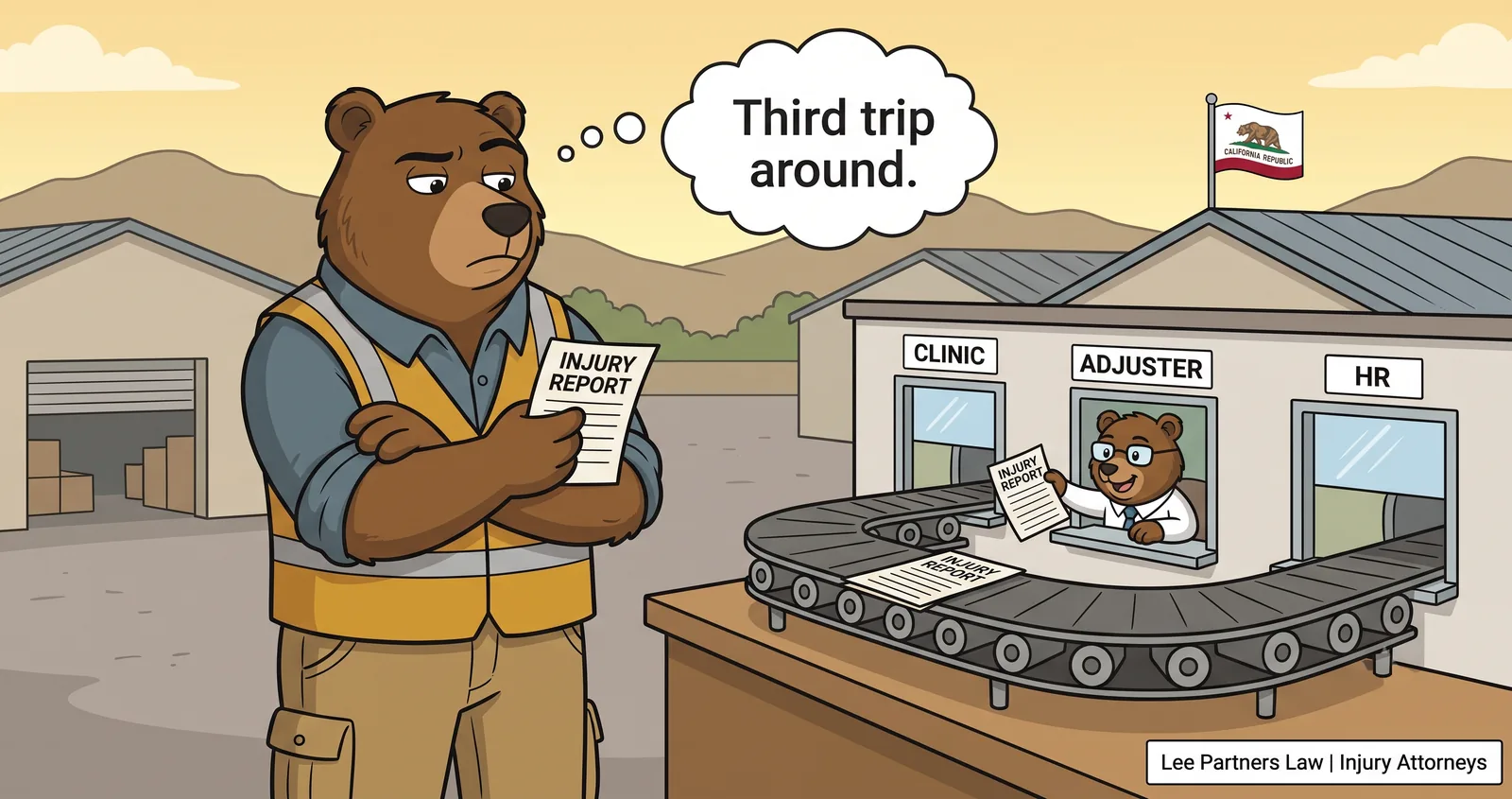

If you were hurt at work in Pomona, Ontario, Chino, Upland, or Rancho Cucamonga, the first problem may be getting someone to take the injury seriously. Your supervisor sends you to the clinic, the clinic sends paperwork to the adjuster, and you are still waiting to find out who is paying for treatment or time off.
Lee Partners Law represents injured workers in Pomona and the neighboring western Inland Empire. We help with disputed claims, medical problems, disability benefits, and settlement questions. You can call or text us even if the employer has not provided a claim form or the insurance company has already sent a denial.
Living in one city and working in another
Pomona is in Los Angeles County, next to communities in San Bernardino County. A worker might live in Pomona and report to an Ontario warehouse, or live in Upland and travel to different construction sites. The city on the paycheck may not be where the injury occurred.
Write down the actual worksite, who supervised you, and which company paid you. These details can matter when identifying the responsible employer and insurer. Crossing a county line for work does not create a different set of California workers’ compensation benefits.
For staffing-agency assignments, preserve both the agency’s information and the business where you were working. Report the injury promptly to both. Depending on the working arrangement, more than one entity may need to be considered. You should not have to guess which business is responsible before telling them you were hurt.
When the work wears you down over time
An injury may begin with a fall, a sudden lift, or a loading-dock incident. It can also develop through repeated lifting, reaching, tool use, or other job demands. A Chino stock worker whose shoulder worsens over months may have a different reporting history from a Pomona maintenance worker hurt in a single fall.
Describe the actual tasks and symptoms rather than trying to choose the right legal label yourself. Our Inland Empire back injury guide discusses back claims, including injuries that develop gradually. The same need for an accurate job and medical history applies when other body parts are involved.
If you work at changing locations, keep a simple list of sites, dates, and employers. That can be especially useful for construction and maintenance workers moving between Ontario, Rancho Cucamonga, and nearby communities.
Hurt at work in Pomona or the western Inland Empire and getting passed from person to person? Call 310-295-0822 or text Lee Partners Law. We can discuss where the claim stands and what needs attention.
Get the injury and work restrictions documented
Seek medical care, explain that the injury happened at work, and describe every affected area. For an emergency, get emergency care immediately. For ongoing treatment, the applicable workers’ compensation doctor and network rules need to be followed.
Report the injury to your employer as soon as you can. Labor Code section 5400 generally calls for notice within 30 days, and a late report gives the insurer an argument it would not otherwise have. However, you have a full year after your injury to file a case. There are exceptions even to the one year rule. The employer must inform you of your right to file a case. If they did not, that one year gets pushed back. Ask for a DWC-1 claim form and keep a copy after submitting it. If the employer refuses or says there is nothing to file, our guide to an employer who will not file your workers’ comp claim explains practical next steps. Keep messages, incident reports, and the name of anyone who witnessed the event.
The work-status note also deserves attention. An employee who handles shipments needs the doctor to understand the actual lifting and repetition involved. If the note is incomplete, ask for clarification rather than assuming the supervisor and adjuster will work it out between themselves.
What if the claim or treatment is denied?
A denial of the entire claim is different from a denial of a particular treatment request. The first may concern whether the injury is work-related or whether you were an employee. The second may concern the medical necessity of a procedure. Those disputes can require different responses.
Read the notice and keep the envelope or electronic delivery information. Our guide to denied California workers’ compensation claims explains the broader claim-denial process. Do not assume a phone conversation with the adjuster has protected every deadline.
Where benefits are available, the case may involve medical treatment, temporary disability during qualifying periods of wage loss, and permanent disability for lasting impairment. The amount and timing depend on the medical evidence and applicable rules. A settlement estimate should not be based only on the city where you work or the name of the injury.
Where would a Pomona-area case be heard?
The DWC has a Pomona district office at 732 Corporate Center Drive. That is a state office, not a Lee Partners Law office. Its existence does not mean every worker in the surrounding cities must file there.
California’s venue rules consider the worker’s residence, the injury location, and in some circumstances the attorney’s principal place of business, with an objection procedure for the attorney-office basis. Someone who lives in La Verne or Claremont and works farther east should have the filing location reviewed using the actual facts.
Use the official district-office page for current contact and visit information. If a hearing is set, follow the instructions for that hearing rather than assuming all proceedings are in person or all are remote.
Common questions from Pomona-area workers
Do I have to go to the Pomona office to start my claim?
No. A claim starts with the DWC-1 form you give to your employer, and the employer’s insurer handles it from there. A case is opened with the Appeals Board only if a dispute needs to be filed, and the venue rules above decide where that case belongs. Most injured workers never need to visit a district office unless a hearing is set there.
I was placed by a staffing agency. Who is responsible for my claim?
In many staffing arrangements the agency is the employer for workers’ compensation purposes and carries the insurance, but the business where you worked may also have obligations depending on the arrangement. Report the injury to both, keep the paperwork from both, and let the responsibility question be sorted out from the actual facts rather than from what either one tells you on the phone.
What does it cost to talk to a workers’ comp lawyer?
The consultation with Lee Partners Law is free. In California workers’ compensation cases, attorney fees are not paid up front. They come out of the benefits recovered at the end of the case as a percentage that a workers’ compensation judge must approve. If nothing is recovered, no fee is owed.
Talk with Lee Partners Law about the next step
Our attorneys previously represented insurance companies. We now use that experience to represent injured workers, examining the medical reports, job duties, benefit history, and defenses that affect the case. For a first conversation, it helps to have the employer’s name, injury date or period, latest work-status note, and any insurer letters available.
We serve workers in Pomona and the surrounding communities without asking them to become experts in claims paperwork before seeking help. Whether you are still working, off work, or unsure why the case is stalled, we can start with the problem in front of you.
Call or text us for a free consultation. Tell us where you were working, what happened, and what the employer or insurer has told you so far.
Prefer to write? Use the contact form just below this article and we will get back to you.