

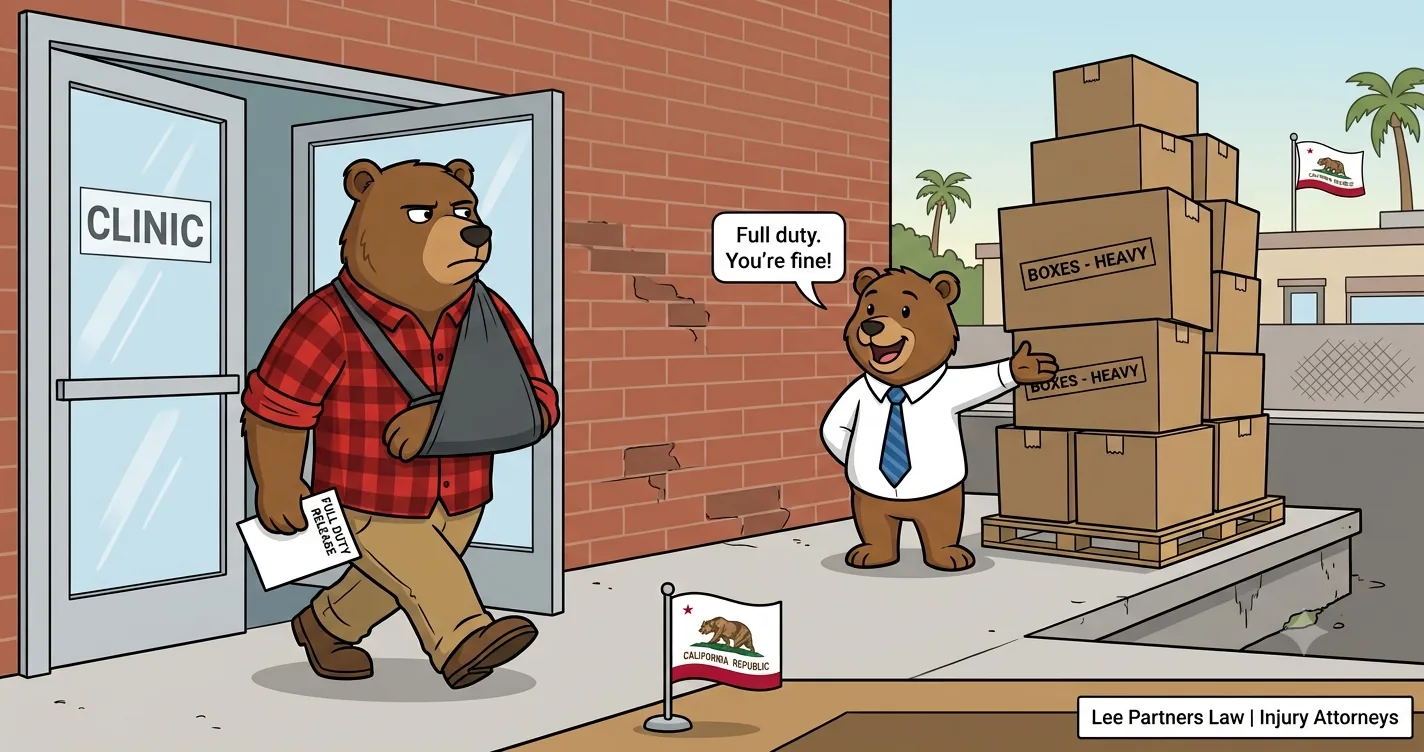

You tell the doctor your shoulder still hurts when you reach overhead. The appointment ends with a note releasing you to full duty, and your employer expects you back for the next shift. You are left wondering how you are supposed to do the same work that you could barely manage before the appointment.
A return-to-work release can affect both your job and your disability checks. If you disagree, the next step is to get the medical record and your actual duties lined up, then address the disagreement through the proper process. Simply telling the adjuster that you are still hurting may not be enough.
Start with the actual work-status note
Ask for a copy of the release and the visit report. Find out whether you were released without restrictions, released to modified work, or declared permanent and stationary. Those are different decisions, even when they happen at the same appointment.
Look for what the doctor recorded about lifting, reaching, standing, driving, and repetitive movement. A note that says you can lift a certain amount occasionally does not necessarily address a job that requires the same lift hundreds of times throughout a shift.
For example, a stockroom employee in North Hollywood might be able to lift one box during an examination but struggle with repeated overhead stocking. A Burbank production worker might manage a short walk but have trouble carrying equipment for hours. These are examples of job demands the doctor needs to understand, not reasons to exaggerate symptoms.
Explain what happens when you try to do the work
Bring a short, accurate description of your duties to the next appointment. Instead of saying only that your back hurts, explain which task brings on the pain, how long you can do it, and whether you develop weakness, numbness, or other symptoms. Tell the doctor about changes since the last visit.
Useful records include your job description, the latest work-status note, any written modified-duty offer, and messages about what your supervisor expects you to do. Keep a brief record of actual difficulties at work rather than relying on memory weeks later.
Ask the doctor to address the specific tasks that concern you and whether restrictions or further evaluation are appropriate. A restriction should come from a medical assessment, not from a number you picked because it sounds reasonable.
Released to work but unsure how you can perform the job? Call Lee Partners Law at 310-295-0822 or text us about the release. We can review the work-status issue and explain your options in a free consultation.
What if you disagree with the doctor?
Sometimes the problem is missing information that the treating doctor can address in a follow-up report. In other cases, a formal medical dispute needs to be raised. Depending on the issue and the stage of the case, the process may involve a qualified medical evaluator, known as a QME, or an agreed medical evaluator if you are represented and the parties agree.
Do not let the report sit unopened. Object and start the PQME process. route after the objection depends on the particular decision. Our explanation of what happens after a QME report describes why the report’s contents matter.
Changing your treating doctor may also be an option, but network and procedural rules apply. Read our guide to changing a workers’ comp doctor in California before assuming you can simply move treatment anywhere you want. A doctor change does not automatically erase the earlier release.
Can your disability checks stop even if you still hurt?
They can. Temporary disability concerns wage loss caused by the work injury during recovery. Pain by itself does not establish that you are medically unable to work.
If the doctor gives restrictions and your employer cannot provide suitable work, temporary disability may remain payable if you otherwise qualify. If work is offered, compare the actual duties with the medical restrictions. Calling a position “light duty” does not explain what you will be asked to do.
Keep your employer informed and seek prompt medical clarification if the assigned work conflicts with your restrictions or your condition changes. Ignoring the release, disappearing from work, or quitting without advice can create additional problems. We litigate disputes all the time about shame BS offers. If it is not a real bonafide offer within your work restrictions you are entitled to total temporary disability.
Common questions about a release you disagree with
Can I refuse to go back to work if I am still in pain?
Refusing to report for work that a doctor has released you to perform can put both your job and your temporary disability benefits at risk. The safer path is to report as directed while getting the restrictions or the dispute on the record quickly. Tell your supervisor in writing about any task you cannot perform safely, and get medical advice before you decide to stop working.
How long do I have to object to the doctor’s release?
For a dispute about your ability to work, the objection period under Labor Code section 4062 is generally 20 days from receipt of the report if you are represented and 30 days if you are not. Other procedures have their own timelines, so read every notice as soon as it arrives and get advice before the shorter of the two periods runs.
Does a full-duty release end my workers’ comp case?
No. A full-duty release mainly affects temporary disability payments and your work status. Your right to medical treatment, any permanent disability, and the rest of the claim continue to depend on the medical evidence and the procedural history of the case. If the release is wrong, it can be challenged through the medical-legal process rather than accepted as the final word.
Help for injured workers in the San Fernando Valley
Lee Partners Law represents injured workers in North Hollywood, Burbank, and the surrounding Valley. Our San Fernando Valley workers’ compensation page explains the broader help available with claims, treatment, and benefits.
We previously represented insurance companies. That experience helps us recognize when a work-status dispute needs better job information, a more complete medical report, or formal action. The starting point is understanding what the doctor actually decided and whether the evidence supports it.
If you are being sent back to work before you believe you can safely do the job, call or text us. Have your latest release and any job offer available so we can discuss the specific problem. The consultation is free.
Prefer to write? Use the contact form just below this article and we will get back to you.


