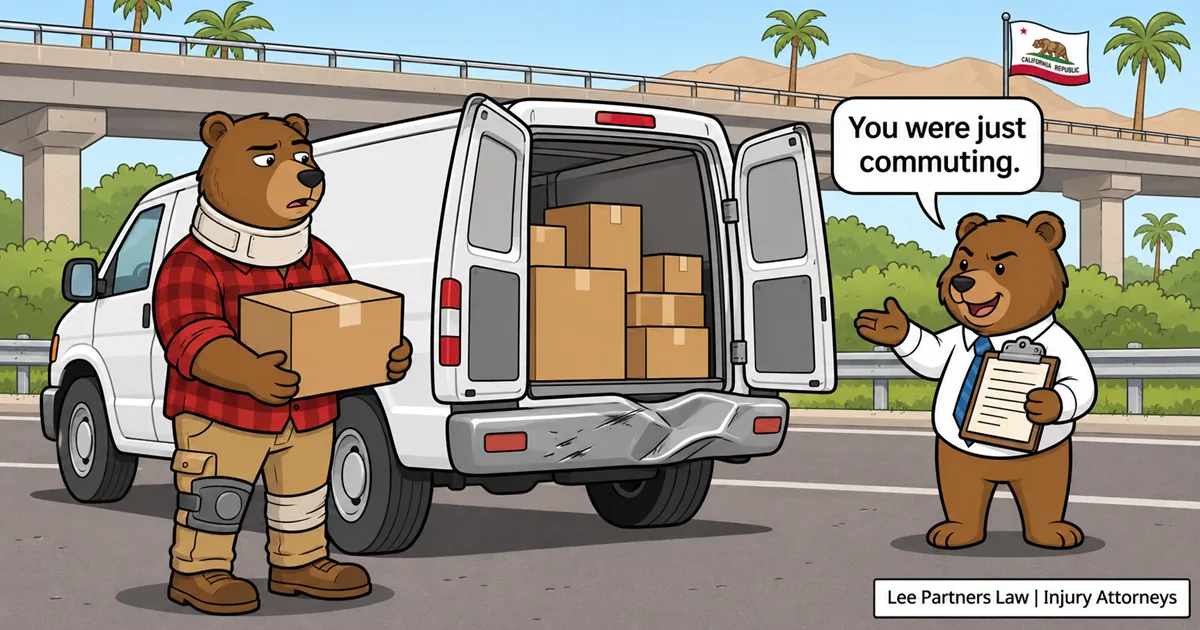

You were rear-ended on the 101 on your way in to work. Or you were hit on the 91 heading home to Riverside after a ten-hour shift. You call the insurance company, and the adjuster tells you there is nothing they can do because you were “just commuting.”
That is the going and coming rule. It is real, and it does defeat claims.
It also has so many exceptions that California courts have said the exceptions sometimes threaten to swallow the rule. I spent about 15 years on the defense side before I started representing injured workers. I raised this defense, and I know how often it gets asserted in cases where it does not apply.
What Is the Going and Coming Rule?
Workers’ compensation covers injuries that arise out of and happen in the course of your employment. The going and coming rule says your ordinary commute is not part of your employment. If you are hurt during your normal trip between home and your regular workplace, the injury is usually not covered.
The California Supreme Court adopted the rule in 1916 in Ocean Accident and Guarantee Co. v. Industrial Accident Commission, 173 Cal. 313. The idea is that you are not doing anything for your employer while you drive in or drive home, so the everyday risk of traffic falls on you.
You will not find the rule in the Labor Code. Judges created it, and judges have been carving exceptions out of it for more than a hundred years.
In Hinojosa v. WCAB (1972) 8 Cal.3d 150, the Supreme Court described the rule as covering a local commute, to a fixed place of business, at fixed hours, with no special circumstances. When one of those pieces is missing, the rule starts to break down. And in Price v. WCAB (1984) 37 Cal.3d 559, the court said reasonable doubts about whether the rule applies are to be resolved in favor of the injured worker.
Why This Matters in Los Angeles and the Inland Empire
We drive. A lot.
Workers come into Los Angeles from Riverside and San Bernardino every day on the 10, the 60 and the 91. The 101 is packed from the Valley through Hollywood into downtown. Crews drive from job site to job site across the region, and the Inland Empire’s warehouses put thousands of trucks and delivery vans on the road before sunrise.
So a rule about driving injuries hits Southern California workers harder than almost anyone. And because so many jobs here involve company vehicles, changing job sites and employers who call at 6 a.m. asking you to stop somewhere on the way in, the exceptions come up constantly.
I represent injured workers across Los Angeles and the Inland Empire, and driving injuries are some of the most commonly misjudged cases I see. Workers assume they are not covered and never file. If that sounds like you, call me or text me at 310-295-0822 before you write the claim off.
Delivery Drivers: Driving Is the Job
Delivery drivers are the biggest group of workers who get told “you were driving, so it is not covered.” For an employee on a delivery route, that is wrong.
The going and coming rule is about getting to work. If you drive for Amazon, UPS, FedEx or DHL, the driving is the work. The same goes for route and distribution drivers at companies like Sysco, US Foods, Coca-Cola, Pepsi and Frito-Lay, and for grocery fleet drivers at chains like Stater Bros. and Albertsons. Once your shift starts, you are in the course of your employment for the whole route. That includes:
- A crash while driving between stops
- A fall on a customer’s steps or driveway
- A dog bite at the door
- A back or shoulder injury from lifting and carrying packages
- An injury while loading the van at the station or warehouse
Fault generally does not matter. Workers’ compensation is a no-fault system, so you can be covered even if the crash was your mistake.
Two things delivery drivers should know:
- Many Amazon and FedEx routes are run by smaller contractor companies. If one of them hired you, you are still an employee, and that company is required to carry workers’ compensation insurance for you.
- Your drive from home to the station or yard at the start of your shift is usually still an ordinary commute. That can change if you take the company vehicle home, or if you are required to use your own car to make deliveries, as many pizza and auto parts drivers are.
The Inland Empire is the center of this work. Amazon is one of the largest employers in the region, and the warehouse and delivery hubs in Ontario, Fontana, Rialto, San Bernardino, Riverside and Moreno Valley send drivers out across Southern California every day. If you also work inside the building, see our guide to warehouse injuries. If you were hurt behind the wheel, see our guide for workers hurt in a truck or car accident while working.
If you drive a route and your claim was denied or never filed, call or text me at 310-295-0822.
The Main Exceptions
Even if you do not drive for a living, your trip may be covered. None of these is automatic. Each one depends on the facts of your job and your trip.
- You had already arrived. The commute ends when you reach property your employer owns or controls, and that usually includes the parking lot.
- Special errand. Your employer asked you to do something out of the ordinary, like picking up supplies on the way in, coming in outside your schedule, or making a drop-off on the way home.
- No fixed workplace. Your job site changes, or you travel between locations during the day, as construction crews, technicians and field sales reps do.
- Employer transportation. You were riding in a company vehicle, crew truck or van your employer arranged.
- Required vehicle. Your employer requires you to bring your own car to use on the job.
- Paid travel. You are paid wages for your travel time, or your employer covers your travel expenses.
- Special risk. Your job exposed you to a particular danger near the workplace that the general public does not face.
- Home as a work site. Your employer requires you to work from home, so the drive to the office is travel between two work locations.
- Business travel. You were out of town for work. That falls under the commercial travelers rule.
- Medical appointments. You were hurt driving to or from treatment for an existing work injury.
When the Rule Does Bar the Claim
I am not going to tell you every commute case is a winner. Many are not.
The classic losing case is the same route, to the same workplace, on the same schedule, in your own car, with nobody paying for your time and no errand for the boss, and a crash on a public road before you reach the premises. A long drive does not change that by itself.
The law keeps moving, though. In a 2026 panel decision, Hernandez v. Ceja Reyes, Inc., the Appeals Board found a farmworker’s injuries in a van crash on the way home were covered. His drive of about 60 miles was not “local,” and his hours changed daily, so they were not “fixed.” Panel decisions are not binding, but if your drive is long and your schedule is irregular, that is worth a careful look.
If the adjuster told you that you were “just commuting,” that is the insurance company’s position. It is not a ruling from a judge. Call or text me at 310-295-0822 and I will tell you whether I see an exception.
What to Do If You Were Hurt Driving To or From Work
- Report it to your employer in writing, even if you are not sure it counts. A text or email is fine.
- Ask for a DWC-1 claim form and file it. Your employer does not get to decide on its own that the rule applies. We walk through it in our step-by-step guide to filing a California workers’ compensation claim.
- Save the evidence of why you were driving. Keep the text asking you to stop at the supplier, your route or schedule for that day, and pay stubs showing travel time or mileage.
- Be accurate when the adjuster asks where you were going and why. Do not leave out the work reason for the trip.
- Do not treat a denial as the end. Going and coming denials are common, and many are wrong. Here is what to do after a California workers’ compensation claim is denied.
If workers’ compensation truly does not apply, you may still have a civil claim against the driver who hit you, and you may qualify for state disability benefits through EDD.
Frequently Asked Questions
Does workers’ comp cover a car accident on the way to work in California?
Usually not, if it was an ordinary commute to your regular workplace. It may be covered if an exception applies, such as a special errand for your employer, a company vehicle, paid travel time, a job with no fixed location, or an injury after you reached your employer’s premises.
Are delivery drivers covered by workers’ comp in California?
Yes. If you are an employee, driving is the job, so injuries on your route are covered, including crashes, falls and lifting injuries. That is true whether you work directly for a company like UPS or for a contractor that runs routes for Amazon or FedEx.
Am I covered if I am hurt in my employer’s parking lot?
Generally yes. Once you are on premises your employer owns or controls, the commute is over and the going and coming rule normally no longer applies. Disputes tend to involve shared or leased lots.
Serving Injured Workers Across Los Angeles and the Inland Empire
Lee Partners Law represents injured workers throughout Los Angeles County and the Inland Empire, including Los Angeles, Van Nuys, Long Beach, Pomona and the western Inland Empire, Ontario, Fontana, San Bernardino, Riverside and Moreno Valley, along with Orange County and the High Desert. If the 101 is your daily drive, see our San Fernando Valley guide.
We are a fully remote firm, so you do not have to get back on the freeway to meet with us. Everything can be handled by phone, text and video.
Talk to Me About Your Case
I am a California Certified Specialist in Workers’ Compensation Law, and I spent years on the insurance company side raising the going and coming defense before I started fighting it. My brother Michael and I will look at your trip, your job and your employer’s role in it, and tell you plainly whether we think you have a case.
The consultation is free.
You can also send us a message using the form below.
This article is general information about California workers’ compensation law and is not legal advice about your specific case. Every case depends on its own facts.